

Comparing Notes
I’d love some input on this one!

Today’s post is a bit of a departure from my usual fare, but since I’m fortunate enough to be associated with this fine and growing community of presumably somewhat like-minded “tortoises” (and recovering “hares”), I’d love to tap into your thoughts and experience on the subject of—drumroll, please—notebooks.
I’m assessing my current… let’s call them systems for what’s already working pretty well and what could use some adjusting for this particular stage of my life. I’m fond of journaling and note-taking as practices, and I’m often fascinated when I happen across posts about commonplace books, although I’ve never officially kept one. I’ve been writing in notebooks for decades, but I’m neither consistent nor particularly organized about it.
I’ve experimented with which kinds of writing media work best for me over the years, and my head and my heart are in some tension over old-school vs. digital means of capturing the things I like to document.
On the one hand, I love the idea of pen & ink, beautiful journals with quality papers, and maybe starting each morning at a lovely writing desk, but that romantic notion doesn’t at all match my lived experience of keeping notebooks. Still, I do believe there are very real benefits to longhand writing, and I want to include at least some of that in whatever approach I decide to go with next.
Digital note-taking, on the other hand, has its own advantages, like being searchable, editable, and legible. I especially love being able to easily attach a photo or screenshot to entries, not to mention how handy it is to have access to digital notebooks almost anywhere via my phone without having to lug around anything extra. Audio notes would be yet another option, although so far, I haven’t explored that much.
For journaling, the reality is that I’m far better at keeping up with a digital journal than a paper one these days, and online journaling apps are easy to organize into sections, so one part can house a true journal or diary while another can serve as a place to record meaningful quotes, and yet another might be for travel planning, rough drafts, or recipes. The possibilities are endless! (And it doesn’t require a wall of shelves to store them all.)
There’s stuff I very much want to write—thoughts, feelings, and creative ideas, along with stories and experiences. But increasingly, there’s also stuff I need to write down and keep track of—such as important medical or financial information. It feels like I have more to note now than I used to—such as medical information for my husband. (If you are here for an update on Bill, feel free to scroll down to the P.S.)
Notebooks are not a new topic for me. I love following Jillian Hess’s stack, Noted, in which she shares dozens of commonplace books from well-known people across time, and Austin Kleon, whose work I admire and who is very generous in sharing things about his own notebooks and process on Substack.
There are tons of great ideas and examples to consider, but the needs and desires of celebrities or famous historical figures don’t necessarily align with those of everyday people when it comes to notebooks.
So I have questions:
What works best for you right now when it comes to note-taking, journaling, or similar daily practices?
Do you like to record everything in one central location, or do you keep a variety of different notebooks for different purposes?
Do you stick with pen and paper, or have you found digital resources that work better for you?
What recommendations do you have for assessing current needs and creating a system that’s well-suited to one’s situation and preferences?
I’m particularly interested in any thoughts and experiences you have to share about keeping a commonplace book.
The commonplace book is a very old tradition, stretching back hundreds of years. In case you aren’t familiar with the term, a commonplace book is simply a notebook in which you collect quotations and other information you find interesting or useful. In other words, it’s where you take and keep notes. So it’s a bit different than a journal or diary, and many people keep both.
Reading Jane Austen with one of my students has reminded me just how essential such practices were back in the days before computers or even typewriters were available.
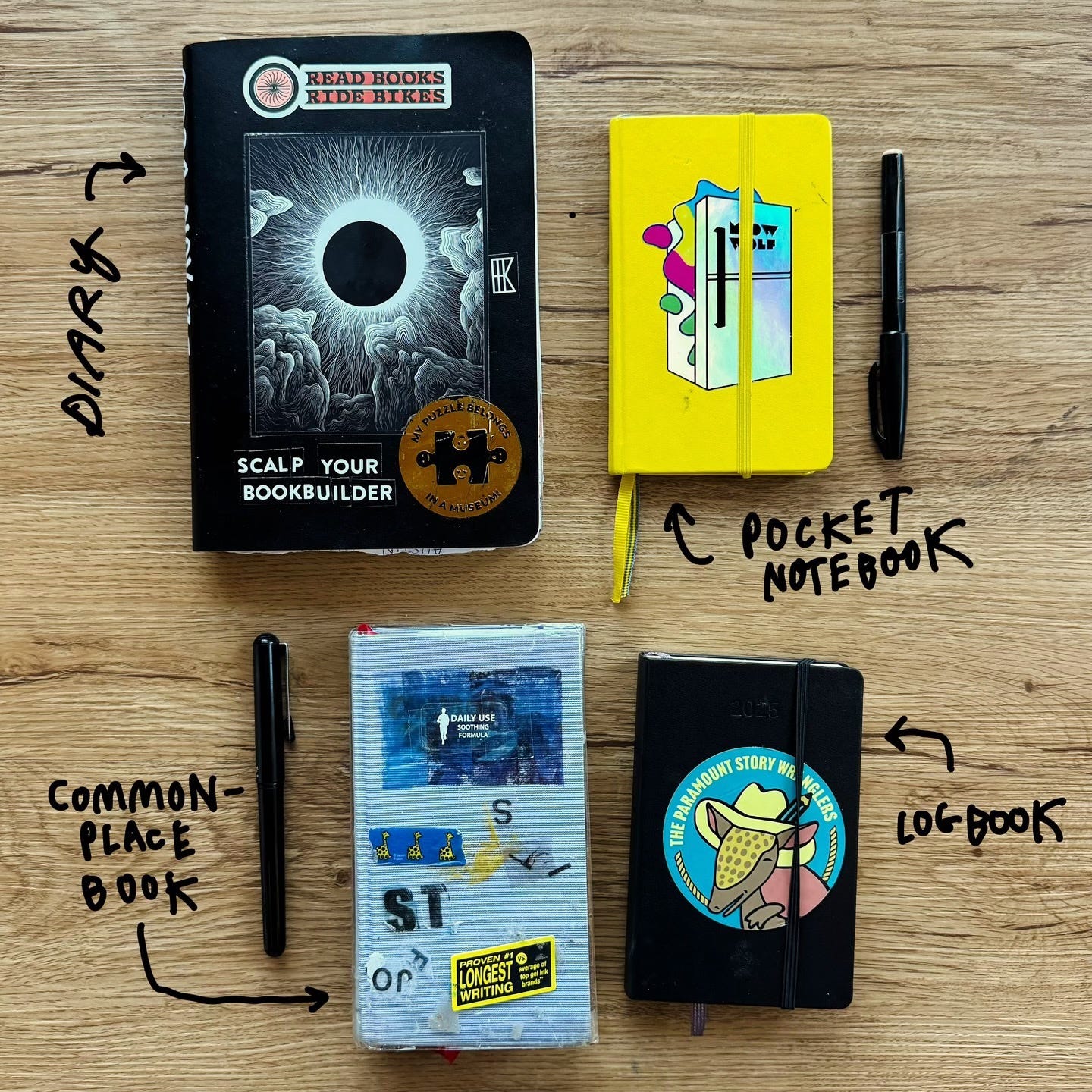
Author Austin Kleon keeps four distinct notebooks: a pocket notebook he has with him most of the time for scribbling and doodling ideas, a logbook in which he briefly records what he does each day (projects, trips, events, etc.), a commonplace book, and a diary. All are analog.
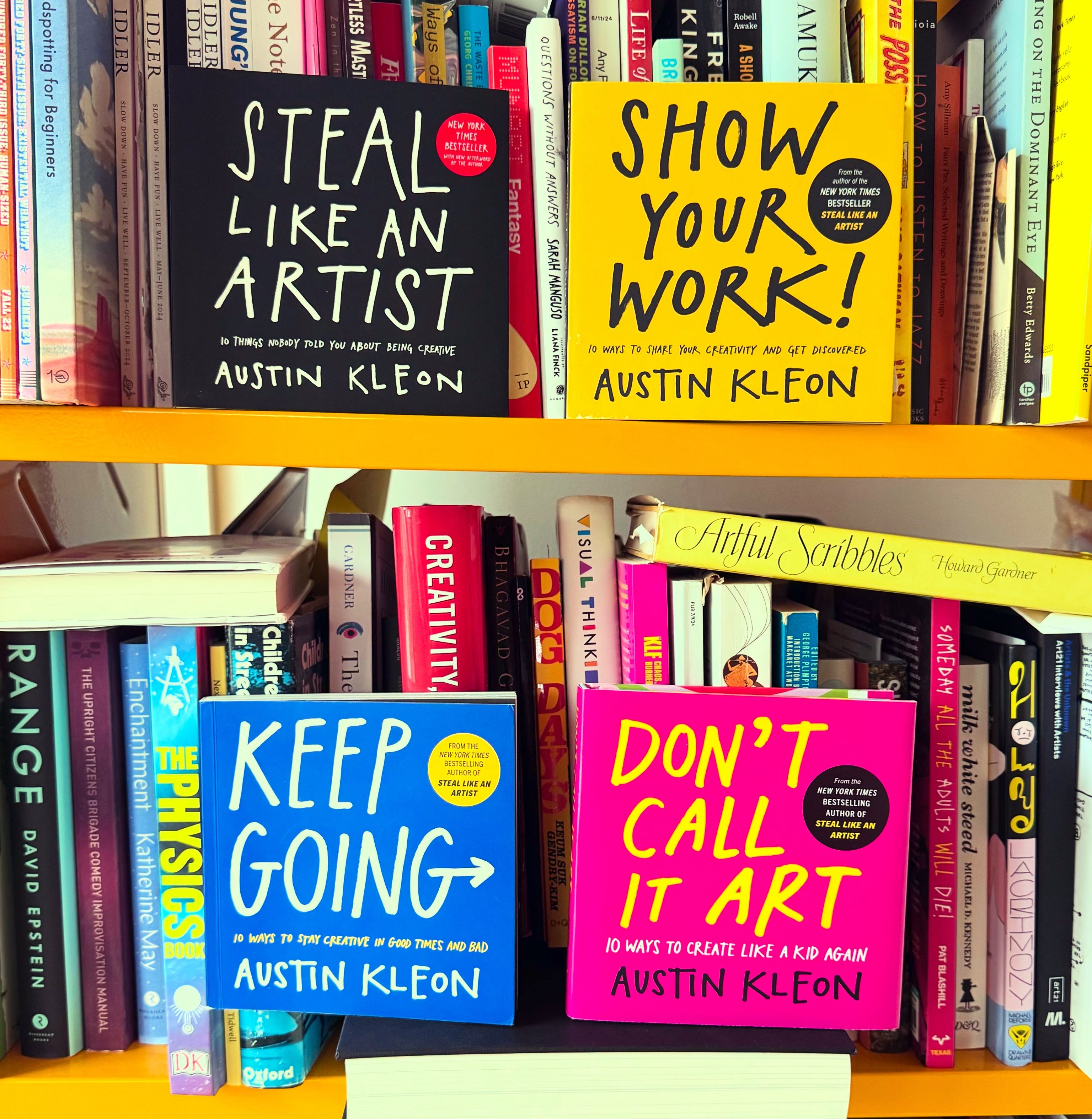
Austin makes a point of explaining that he doesn’t necessarily recommend his system for everyone, but it works for him as a writer with three bestsellers under his belt. My favorite so far is Keep Going, and his fourth book, Don’t Call It Art, hits the shelves in June. Clearly, his system works for him. Austin’s advice to people just getting started with notebooks is to begin with just one, and simply write or draw something in it every day.
Jillian Hess is an English professor at the City University of New York (CUNY). In her Substack, she shares the commonplace books of a wide range of people, from Stephen Sondheim to Beatrix Potter to Carl Jung, and most recently, Florence Nightingale. Her About page links to a short history of yet another type of notebook, the daily planner, which I was fascinated to learn descended from almanacs.
But here is the fun post of hers that ensnared me in the first place, in which the professor shares 12 of her own notebooks of various kinds from over the years:

As for me, I’ve used the Day One app on my phone and tablet for years, and I’ve liked it very much for digital journaling. There is a free version with basic functions, which includes one notebook, but I was disappointed when they went to an annual membership for the premium level (rebranded to silver and gold). With Day One Silver, you can create more than one notebook and post more than one photo per entry, and Day One Gold adds AI features I’m not interested in, but I don’t like paying a steep fee every year.
Recently, I’ve also experimented with the Journal app that comes with iPhones, which I didn’t even know about until a student mentioned it! These apps are super convenient, but I’d like to get back to more longhand writing, so I’m still debating whether to stick with what I’ve been doing or make a change.
I will say that my Day One journaling is the one kind of writing I’ve probably been most consistent about, and I love adding at least one photo to each entry, which makes it much easier to go back and find a particular day. So maybe it would make more sense to save pen and paper for a different kind of writing or notebook and not risk interrupting the most reliable writing I’ve managed to establish.
I have a Kindle Scribe that I use for notes while teaching English online and for vacation planning, and a few other kinds of note-taking. It also serves as an oversized ereader, which has been quite convenient. It’s kinda fun to write in. I use a stylus, so I’m writing in longhand, but it’s easy to erase and highlight or go back to make changes or additions after the fact, and there are different templates to choose from—lined or not, checklists, calendars, etc.
It’s great for my work and projects at home, but it’s clunky to carry around, and I’m paranoid about losing the stylus when traveling. Unlike my Day One entries, it’s not backed up, so if I were to lose it, I’d lose everything. I also have some issues with supporting and/or relying on Amazon. So I’m reluctant to expand my use of that device.
I used to buy pretty, cute, or elegant journals that caught my eye, influenced by Jim Rohn’s suggestion that spending money on a quality journal will inspire you to collect worthwhile things in it. But I don’t like the idea of prejudging what I write as worthy or unworthy of inclusion in a pricey notebook. I also felt like everything should be written neatly in such journals, with great care. I already have enough challenges with perfectionism. Besides, expensive journals have gone way up in price, even as my income has gone down.
These days, I’m inclined to buy a stack of inexpensive composition books in various colors once a year during summer back-to-school sales to use for a variety of purposes. Still, cheap spiral-bound notebooks and ball-point pens aren’t suitable for every application.
I’ve done morning pages, but never tried bullet journaling or other more structured methods. I’ve never kept a sketchbook or scrapbook, although I do think those are valuable practices and worth considering. They don’t come naturally to me, however. I fear the scrapbook idea would become yet another project I spend too much money on and never complete, but doodling in a sketchbook does have some appeal, in spite of a dearth of that sort of artistic talent.
I don’t want to spread myself too thin by trying to maintain a dozen different kinds of notebooks. I’d rather be selective and somewhat practical, but clearly it feels like it’s time to consider some changes, including maybe trying something I haven’t done before.
In case you’ve never given much thought to these matters—or perhaps you have but remain open to new ideas—I’ll share a couple of Substack articles that recently caught my attention and might be of interest. The first is on art journaling, which does look fun when I see other people’s pages, but quickly becomes intimidating when I try to create something even vaguely recognizable myself. Maybe it would get easier with practice?

And these creative ideas for filling empty journals caught my eye because back in my bookstore browsing days, when all of my journaling was by hand, I sometimes enjoyed buying nice journals to write in. But I rarely do that now, although I confess that I kind of miss the whole experience of standing in a huge roomful of books holding various fancy volumes in my hands to figure out which ones spoke to me. Maybe I don’t need a new notebook or writing practice so much as I need to spend more time in bookstores again? Bryant offers some creative ideas here, in any case…

I should perhaps clarify that I’m not looking for things to do in the sense of feeling bored or that I have too much time on my hands—far from it. I just want to assess my (somewhat) daily writing practices and decide if some changes might be in order. At the same time, being a student of life and a note-taker is central to my identity, so I’d like to be mindful of my writing practices and use of notebooks.
How about you…
Is journaling or note-taking a priority?
What works for you? What intrigues you?
I’d love to hear your thoughts in the comments or subscriber chat!
P.S. A quick update on my husband: A week of antibiotics seems to have taken care of Bill’s toothache (for now; he’ll see an endodontist in June), so we think all systems are go for his medical procedure on Wednesday morning, which we hope will prompt his body to patch the elusive spinal fluid leak that has been causing so many troubling—and somewhat debilitating—symptoms since February. We so appreciate all your prayers and good wishes!

I’ve written morning pages for over 30 years. I began writing in composition notebooks, but some years ago I discovered Eccolo World Traveler journals. I love the soft covers, the paper quality, and the size of these journals. I used to find them at TJ Maxx for around $5. I usually have a more generic notebook dedicated to everyday things — current tasks, notes of things I need to do. I’ve been using this notebook less the past year or so; my phone holds notes and reminders, both in memos and photos.
My "journaling," if you could call it that, came about in a more serendipitous way. On January 1, 2013, I decided that I needed to keep an Excel spreadsheet to log my running miles so that I would know when it was time to buy a new pair of shoes. Over time, it has morphed, and is still a spreadsheet, in fact, still the same spreadsheet, but for years now I have recorded all sorts of things I've done each day, in addition to where I am. I record hikes, bike rides, doctor appointments, visits with friends, dinners out, meetings, rehearsals, concerts attended, movies viewed, exercise and yoga classes - all kinds of things. I've also used it to track my sleep patterns off and on (you may identify with that, Lenora, as a fellow insomniac) and the spreadsheet is now at line 5592. I've tried other forms of journaling and was never able to stick with them, but this spreadsheet is quick and easy and is a habit. I can't tell you how often I turn to it to remember when something or another happened or the last time I did fill-in-the-blank. And, by the way, I quit running 8 years ago, so no longer need to to track running miles, but the spreadsheet continues on.