

Imperfectionism
and creating space for what matters most

There are times when life feels like an endless series of recalibrations. No sooner do we get through one chunk of stuff—whether that’s accomplishing a long-time goal like earning your degree or landing a particular job, or managing a crisis like a divorce or a serious health concern—than it’s time to reset for the next round.

Somewhere along the line, we figure out that it matters how we frame things and set our expectations. It can be helpful to focus more on the journey or process than on specific outcomes. If we are here to learn and grow, there are lots of ways to go about that, but there are surely some things we have more control over than others.
Whether you are solidly in the “We chart our own course!” camp or you take more of a curious and laid-back, “I’m just along for the ride,” approach to your life, sooner or later, you are bound to notice some things about yourself—some habits or tendencies—that aren’t serving you particularly well. Maybe they used to work for you, but don’t at this stage, or maybe they never really did. In any case, you become aware that you have habits that are holding you back from being the person you wish to become.
Recently, I’ve been trying to break the habit of waiting until “just the right time” to do things. Too often, my tendency is to kick the can down the road unless conditions are pretty close to ideal. “I’ll do that after I finish this [insert endless task]” or once I’m not so distracted, or next month, or after I’m feeling better, or this summer, or after my next credit card statement, or when I can really do it properly.
There is always a time in the future that might be better... more suitable. But there is also a time when we run out of future, so there’s a balance to strike.
I certainly don’t subscribe to the philosophy that the time is always NOW when it comes to what we want or need to do. Not everything that pops into our heads should be done at all, and not everything worthwhile can or should be done as soon as we think of it. Buying things we can’t afford, for example, is not something I recommend, and some activities really are better suited to particular times of year or seasons of life. I’m not throwing that kind of discernment out the window. But it’s easy to slip into perfectionism about precisely the best time to do things (or to use that as an excuse not to act) and end up never doing them at all.
“I’ll do it once I’m less busy.” is a particular favorite.
If you are about to retire or move from full-time to part-time work, or if there are plenty of times when you are significantly less busy than you are now, then delaying may of course be a reasonable plan. If, on the other hand, it seems you’re always too busy to do the things you claim are important to you, I’d say that’s something to look carefully at. Maybe it’s time to focus on things to stop doing for a while, so you can create space for what matters most.
I’ll do it after I graduate, or when the kids move out, or once my spouse is better, or after I retire. Let’s face it: there’s rarely a perfect time to do anything. Again, it’s possible that it really would be best to wait. It’s also possible that it would be best not to do it at all (whatever “it” may be). Quite often, however, we don’t make a genuine assessment. We slip into a habit that we employ to avoid reaching an uncomfortable conclusion.
I wrote last week about my shift in thinking about my husband’s current medical condition—which I still expect to be temporary—from acute to something more like chronic. One of the things this shift in perception makes possible is for us to find ways to go ahead and live our lives in spite of these current adverse circumstances. It doesn’t mean that we won’t have to make adjustments—including some big ones; it means we don’t let the fact that we can no longer do things the way we used to convince us that we shouldn’t try to do much of anything at all.
This approach applies to more than just dealing with medical conditions. It can apply to any of life's ups and downs, including simply getting older. Can’t eat this anymore? Okay, I’ll eat that instead. Can’t exercise the way I used to? I’ll find new ways. Can’t wear the clothes I used to? Fine, I’ll wear different clothes. Can’t read as I used to? I’ll find other ways to enjoy books and articles. Some of these adjustments will likely be temporary. Others may be permanent or at least long-term. But life goes on... until it doesn’t. So we may as well make the most of it.
I’m not suggesting we never wring our hands about anything. For most of us, that isn’t realistic. I’m reminded of Susan Jeffers’ classic book, Feel the Fear and Do It Anyway. You might say I’m proposing a variation on her theme: Worry if you must, but don’t let it stop you from living your life. (Okay, her title is infinitely better, but you get the idea…)
The grass is always greener on the other side of the fence, as the saying goes (or “over the septic tank” if you ever read Erma Bombeck). Yes, there are people in better circumstances than ours, but there are also plenty of folks who have no grass at all. Rather than putting a lot of energy into deciding who has it worse, we can use that energy to learn from one another about how we might adapt to whatever circumstances we find ourselves in—or even change our circumstances, when possible. There’s a reason tips and tricks are so popular. They can be genuinely helpful.
There was a time in my life when I thought doing things the hard way was almost always best... that I should be making more things by hand and from scratch. One should always send hand-written thank you notes and volunteer to help in every way possible. I don’t mean I actually managed to do everything like Martha Stewart, but I felt guilty about the fact that I didn’t.
Some of us are fortunate enough to have at least a period of our lives when we can make some of those choices if we wish. We may even wonder why more people don’t live the way we are living, until tragedy strikes or some other unforeseen crisis presents itself, and all of a sudden, it’s all we can do to simply put one foot in front of the other. It’s amazing how quickly you can go from fairly well organized and put together to coming apart at the seams.
These days, I’ve accepted that I can’t do it all—and shouldn’t! There are trade-offs, and quite often our time and effort are better spent doing other things, including taking care of our own health so we can continue to do the things that truly matter most to us. Not everything is worth doing, and not everything that is worth doing is worth the energy, effort, or expense of trying to do it “perfectly.” There are better ways to spend our precious time and other limited resources.
Becoming an imperfectionist turns out to have some great benefits, starting with freeing up time (and space in your mind) to focus on things you thought you couldn’t before. Also, it turns out there’s still lots to love about life even when it doesn’t quite work out as you had hoped.
Am I always content? Hardly. But that’s okay, too. I don’t have to adopt the perfect attitude at all times or always say just the right thing. No one else does, and I don’t either. Some folks undoubtedly come a lot closer than I do, but that’s also okay. I don’t have to be the best at everything.
How about you...
Have you noticed that there are times when relaxing your standards or expectations is actually beneficial?
Have you found that accepting the imperfections of others allows you to be more accepting of your own (or vice versa)?
Are there things you used to stress about that don’t bother you as much as they used to?
Not everything has to be optimized or turbo-charged or whatever the buzzword du jour happens to be. In fact, everything won’t be. The world won’t come to an end if we wear colors that aren’t in our optimal color palette. Life’s too short to waste time stressing about every little thing.
Yes, there’s big stuff to stress about, too, and sometimes those things need to be addressed. Amends need to be made. Difficult changes may be necessary. Still, sitting around worrying about it won’t make it better, and positive actions—even relatively small ones—tend to absorb anxiety. So do what you can about it, and let the rest go. If you can’t manage that, let go of the fact that you can’t figure out how to let it go! Life is hard enough without pouring additional stress onto unavoidable stress.
In our case, there are some things we’ll wait to do until Bill is feeling better, but there are also some things we’re gonna go ahead and do as best we can, because there won’t be another spring of 2026, and who knows how many springs any of us will have in our lifetimes?
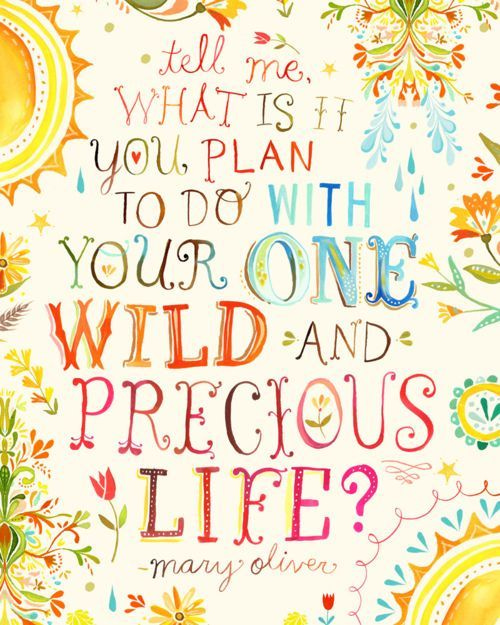
It brings to mind Mary Oliver’s famous question from her beautiful poem, The Summer Day...
Whatever you plan to do, you don’t have to do it perfectly to do it well.
