

The Power of Song
love and music as unifying forces

We live in interesting times. That’s not exactly a newsflash. And you don’t even need a keen sense of history to know this is not our first time nor the first place to face monumental challenges.
Hold on,
Hold on, my dear ones,
Here comes the dawn.— Heidi Wilson
It’s tempting to try to tune out or turn away when we are overwhelmed. Humans have developed lots of ways to numb, many of which aren’t very healthy—excessive use of alcohol, food, social media, or pretty much anything that might distract us from fully feeling all that we feel or facing what we need to face, preferably while we can still do something about it.
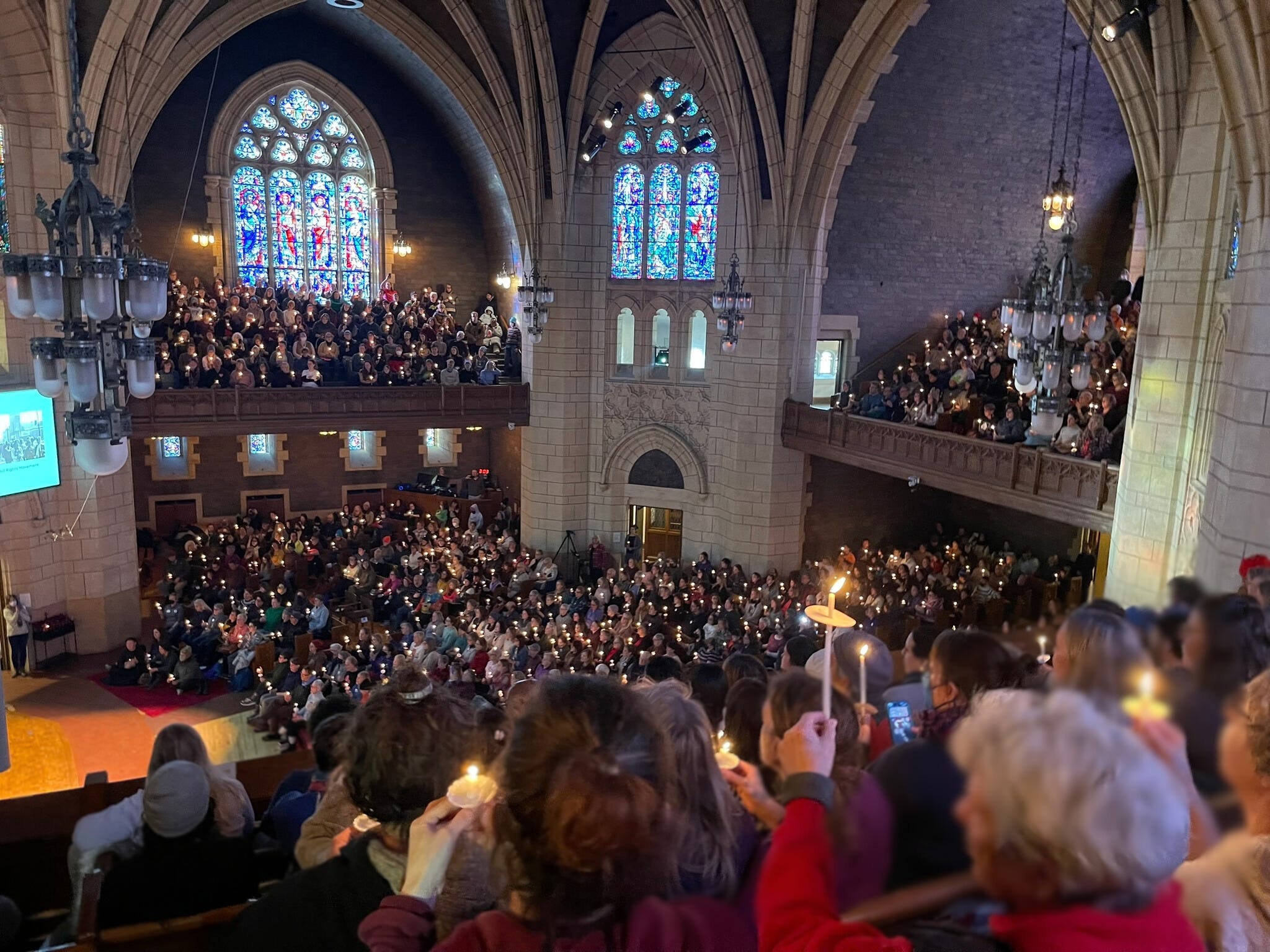
Since the recent events in Minneapolis, there have been conversations across the country about something seeming different recently... a subtle but significant shift of sorts. We are understandably all a bit gunshy by now, having thought so many times in the past decade that surely THIS thing (whatever it might be) will finally make a difference and bring people back to their senses.
We wait expectantly for a turning point, a “come to Jesus” moment like the country saw during the 1954 televised McCarthy hearings when Joseph Welch pressed Senator Joe McCarthy after bullying yet another falsely accused witness with the question, “Have you no sense of decency, sir, at long last?”

Call: We are here.
Response: We are here.
Call: With each other.
Response: With each other.
Together: Our love for each other will carry us through.
It’s worth remembering that we usually tortoise our way to these turning points. They don’t happen overnight. McCarthy had been terrorizing the nation since at least 1950 with his wild allegations of communist activity, and even after the tide of public opinion turned during those 1954 hearings, it took nearly another year for the Senate to censure him. Only in retrospect can we point to a moment when critical mass is reached.

We walk in love, united in purpose.
We join our hands and lift up one voice.
We speak the truth with strength and compassion,
Resounding with hope, with courage and joy.
We cry for peace and rights for all people.
We welcome friends from far and near.
We fight for those whose voices are silenced.
Resisting in faith until all are free.
We dream a world of justice and kindness.
We build a bridge, creating new paths.
We march with joy as all walk together,
Embracing each one, we boldly stand.
— Deanna Witkowski (inspired by Lift Every Voice and Sing)
Most recently, the incredibly well-organized and peaceful yet tenacious community response to ICE overreach in Minneapolis has highlighted the intentional ways Minnesotans demonstrate care for their neighbors. Although the violent disregard for due process has been horrifying, I have found the ways that the community has come together to embrace and support one another to be not only encouraging but truly inspiring. We have even seen a few more high-profile Republicans willing to push back on some of the worst abuses recently. All of these things matter.
As a musician, however, the sign of a shifting landscape that has especially stood out to me hasn’t been discussed as widely. It has to do with the use of singing as a unifying force for good. In this age of personal electronics and earpods, it’s actually quite remarkable.
I really wanted to highlight the community singing out of Minneapolis in my roundup last week, but most of the examples I found on social media were short-form videos that were not easily shared in a Substack newsletter. Since then, Anderson Cooper did a nice segment about the Singing Resistance on CNN, which I encourage you to watch if you haven’t seen it yet.
And last weekend, CBS Sunday Morning aired a feature story on Jesse Welles and American folk music.
Too often, we think of music as relatively inconsequential, but music can be powerful, and raising our voices together in song is uniquely so. It affects our nervous systems and moves our internal thoughts and feelings out into the world in a potentially constructive way. It helps us gather our courage and strength and can serve as a vehicle for grief and even rage. Singing together is often a source of great solace and helps us focus when we may be tempted to tune out. The people around us also take notice. Some may even decide to join in. When we lift our voices together, we literally create shared resonance.
Singing together is hardly new. People have been singing and chanting in groups for centuries. Chanting in worship services allowed holy words to travel throughout even large spaces long before we had microphones. Singing is one of the best ways children—and adults, for that matter—remember what they are learning. (ABC song, anyone?) It’s also a wonderful way of expressing ourselves, both collectively and independently. Lullabies have been soothing fussy babies ever since humans walked the earth. Songs and chants can be key components of worship, prayer, meditation, and other religious teachings and experiences.
Music has often played a role in resistance and even war. Drums and calls alerted tribes when danger was present and sometimes relayed coded messages that the enemy wouldn’t understand. Drums and fifes signaled strategic moves on the battlefield during the American Revolution. Spirituals allowed enslaved workers to pace themselves for survival during backbreaking work on plantations and helped create a sense of community even within a hostile environment. Freedom songs and chants were an important part of overcoming Apartheid in South Africa and also served as a unifying force in the American Civil Rights movement.
Singing together in community can be a truly uplifting experience, especially when the words and melodies reflect messages of peace, love, and hope. It’s not easy to sing in frigid temperatures, but the people of Minneapolis have been raising their voices in song together for weeks, and I believe it’s making a real difference.
Music reflects a range of human experiences, from soulful to lighthearted and even humorous, and can have a balancing or restorative effect when needed. It can also serve as a throughline connecting us with previous generations.
The Reverend Dr. Martin Luther King, Jr. invited Joan Baez to lead the people in song at the March on Washington in 1963. The message that We Shall Overcome still resonates today.
Singing can help us convey messages we might not receive or retain from a speech or article. Music has the power to move us deeply and tends to stay with us.
Music can also remind us and others of what we already know but may have lost sight of. Creating music together, in particular, tends to strengthen our connections not only to each other but to our bodies and our origins.
Music also takes us back in time, acknowledges hard truths, and reactivates suppressed hopes and dreams even as it calls on our courage not to give up.
In skilled and compassionate hands, music can bring important stories front and center, raising awareness, calling us to action, and making what’s happening less likely to be forgotten, minimized, or erased. Most recently, Bruce Springsteen used his well-established voice to highlight the crisis in Minneapolis, effectively laying down a marker for what’s happening there.
I’ve long been a big proponent of listening. One of my favorite reminders to my children’s choirs was always, “Listen harder than you sing.” I’m an even bigger proponent of participation. Adults often get self-conscious about singing and claim they can’t. But after decades of teaching voice lessons and directing choirs of all ages, I can say with some authority that almost anyone who can speak can learn to sing with a little practice.
I’m not claiming you’ll be the next Beyoncé, Frank Sinatra, or Renée Fleming. But your voice can do more than you may realize. Just start simply and gently, and keep listening even as you sing. Do a little every day. Scroll up to any song above that appeals to you and quietly sing along. If none of these are your style, rest assured that there are others on YouTube or your music streaming service of choice that are.
You can even start by just humming, tapping your foot, or swaying your body to feel the music. If you aren’t yet good at melody, focus on the rhythm (or vice versa) until you gain a little confidence. It’s okay to experiment. Maybe try reciting the words as poetry. Sit next to someone with a nice voice in church and learn from what they do. If you squeak or your voice does something else you didn’t intend, just pause briefly, take a breath, and ease back in. The more you sing, the easier it gets, and the more reliable your voice will feel.
Allow yourself this outlet as a meaningful way of connecting with others. Both you and your sphere of influence will benefit.
If you’ve been singing in the shower for years or while you get work done around the house or in the garage, maybe it’s time to find a community choir to join or a community voice class to sign up for! (Yes, there are such things. I taught them for years.) You might even find a Justice Choir Chapter in your area, if that appeals to you.
Don’t let that rude kid from second grade who made fun of your singing keep you from enjoying something you have always wished you could do some 30+ years later. In the CBS piece above, singer-songwriter Jesse Welles confesses that his sister told him he had a voice like burnt toast.
Similarly, I believe everyone can find ways to be active in their community. That doesn’t mean you have to become “an activist.” You can start small: smile and wave at a neighbor. Welcome someone new. Teach someone something you know how to do and they want to learn—gardening, cooking, knitting, fixing things. Maybe you can help out at your local school, library, or after-school program. Or you could visit the animals in a nearby shelter.
There might be an event you could help organize in your apartment building or on your street. Or maybe there’s an already scheduled event you could attend with a neighbor at a local church, synagogue, mosque, or community center. (Hint: Some of these might include a chance to sing.) You could write letters, postcards, or emails to your legislators about causes that are important to you. If there’s a rally in your community that looks manageable, find a friend to go with. There will likely be some call & response chants to join: This is what democracy looks like!
If you’d like to participate in a rally but don’t have transportation or the mobility to march, offer to make a sign (or snacks! or a warm scarf!) to send with someone else. Or simply encourage others who are going and let them know their efforts are appreciated.
Please don’t be afraid to get creative, and try not to become discouraged if your first couple of efforts don’t immediately take off. We crawl before we walk. Share ideas in the comments or subscriber chat, if you’d like. Find ways to use your voice and spread a little love, no matter how small. If everyone did this for even a few minutes each day, the world would be a better place for all of us.

❤️
This piece beautifully captures how communal singing shifts from performnace to presence. I've noticed in my own community organizing that moments when people start harmonizing together often mark when a gathering turns into a real movement. The nervous system stuff you mention is spot-on, theres real science behind why chanting together makes fear less paralyzing.