

A Penny for your Thoughts
thinking about... thinking

Boredom is not something I experience very often… at least not in the sense of being unable to find something I’d like to do. I’ve never understood people who say they can’t retire because their life would be too boring, or those who caution against taking more than a week of vacation at a time because “you’ll go stir crazy.”
Come to think of it, I’m not sure people say those things as often as they used to in the days before the internet—along with streaming services and such—put so much at our fingertips. Still, boredom has long been considered something to avoid.
I recently watched a TED talk by Manoush Zomorodi, however, which suggested, based on conversations the investigative journalist had with experts, that boredom can actually lead to brilliance. I found that idea intriguing…
Admittedly, the kind of boredom Manoush is referring to is a bit different than what I described above as something I rarely experience and don’t even fully understand. I can absolutely get bored when I’m stuck doing something I’d rather not do—especially work that is repetitive and not very interesting.
It turns out this kind of boredom is actually great for us because it gives our brains a chance to roam and tends to spark creativity. In fact, our brains need this kind of opportunity from time to time to do their best work.
The challenge is that these days, we don’t have much patience with this sort of boredom. The moment we feel the slightest lull, we tend to reach for our smartphones or anything else we can use to fill the moment. Many of us are uncomfortable with extended silences or being alone with our own thoughts. Even if we are not that uncomfortable, we’ve been socialized not to “waste time” daydreaming or otherwise piddling around.

Ironically, we can miss out on amazing opportunities as a result of “keeping busy” in contrast to, say, paying attention. This impulse to fill every gap can also negatively impact conversations and relationships. We often don’t fully take in what we hear, as we are too busy formulating our next statement to listen well. It also means we don’t always do a good job of processing what happens to us in real time because there’s constant pressure to move on to the next item on a long list.
As a result, by the time we are ready to go to bed at night, our minds are filled with all the unprocessed flotsam and jetsam from our day—often from multiple days. Every worry or problem we hurriedly pushed aside so we could smile and meet the next client, student, patient, or prospect comes rushing back when we finally put our feet up and close our eyes to rest. This habitual cycle is, of course, anything but restful.

The resulting chronic insomnia only contributes to our dilemma. Without sleep, we can’t possibly think clearly or efficiently. Once we have stared at the ceiling for a few minutes, we reach for our phones or other distractions, or we drink alcohol to try to relax, or we resort to medications that really shouldn’t be used long-term.
No one can resolve every concern as it arises. Delays are inevitable and sometimes even desirable, as it takes time to work through complex situations. But when we don’t give our minds enough space to function well, we don’t function well, especially when innovative solutions are called for. In turn, neither do our families, places of business, or communities.
I have fond memories of daydreaming as a child. I remember the old tilt-in windows of our elementary school classrooms and the view through them. I recall the big round clock on the wall above the chalkboard and the inadequate fan on a rolling stand at the front of the room. In years when we were seated in alphabetical order, there was Elaine Halisey’s long, wavy hair cascading over the back of her chair in front of me.

I mentally worked through a lot of stuff while staring at those familiar and even comforting things. There was no cell phone in my pocket, no texting or emailing to be done, and if I wanted to look something up that wasn’t in my textbook or any of the five encyclopedias on our shelves at home, I needed to make arrangements to physically go to a library.
For the most part, I don’t miss those days when tracking down a copy of the novel that your class was required to read could take days or even weeks, with trips and phone calls to multiple stores, because nearly every 6th grader in the county was reading it at the same time, and everyone was out of stock. I love having access to the internet and other modern technology, in spite of the challenges that come with it.
What I do miss is the time to ponder that was once inherent in everyday life… while grading papers, hanging clothes on the line, gardening, or maybe even golfing with a client. Yes, some of us still cut our own grass, fold clothes as they come out of the dryer, bake bread, or go to the gym, but increasingly, even the repetitive physical tasks we do regularly are accomplished in front of screens, on our cell phones, or with earpods in place. They less often encourage us to simply be with our own thoughts.

In other words, today, we have few opportunities to experience the magic of boredom.
I’ve heard quite a few people say over the years that they have some of their best ideas in the shower. It’s true for me. I don’t think that’s happenstance. My showers often last long enough for me to think through conversations or consider problems. Some of my Substack posts start in the shower!
I’m not saying we don’t think enough. Our minds race constantly. It’s more a matter of what kind of thinking we are doing—what we allow time for. Most of us are habitually calculating: What will this cost? What will bring in the most clients/money/views/clicks? Will this cause a problem? How much time do we have? Calculating is only one type of thought process, however.
Nor am I advocating for more showers or suggesting that people shouldn’t listen to audiobooks or podcasts. What I want to encourage is scheduling choices that deliberately include less-structured and screen-free time each day for more free-flowing and potentially creative thinking. That is, time—preferably well before our bedtime—to let our minds wander and notice or think of things we were too busy for in the more structured parts of our day.

There are lots of ways to do this, depending on your preferences. Morning pages or other forms of journaling are a common choice. Another good option in mild weather is walking outside—preferably with no earbuds—or at least not listening to a book or podcast. (Gentle music might still allow for the kind of thinking you want to facilitate.) Even simpler would be sitting and staring out the window, as I occasionally did in elementary school. Perhaps a few minutes each morning with your coffee or tea. Cooking, doodling, knitting, playing with the dog, or doing some yoga are all popular ways to give your brain a break from the kinds of activities it does at work all day.
My grandfather liked to make or fix things with his hands. My grandmother loved to sit and crochet in the evenings. Some people like to paint, write poems, sculpt, sing, dance, or play an instrument. (Even if you can’t play an instrument, most of us can listen to one.) In essence, we are giving our left brain a break by shifting to right brain activites.
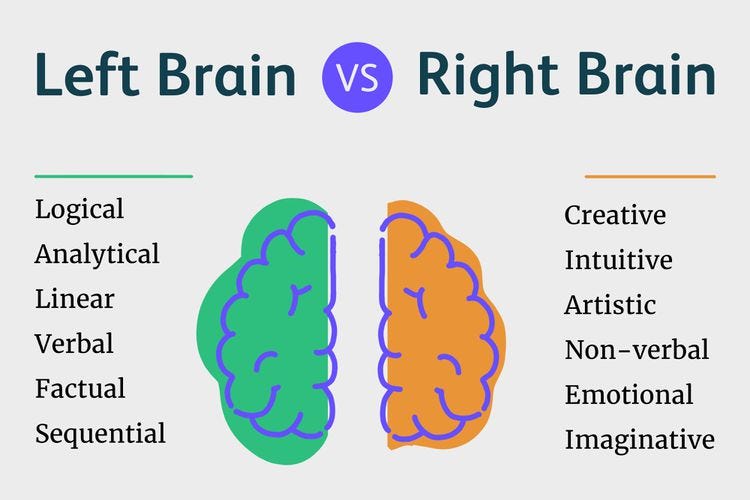
Please note that none of these recommended activities involve scrolling on a screen in search of another dopamine hit. Again, I’m not against using visual technology in moderation, but as someone who has struggled with insomnia for decades, I’m interested in NOT spending every night staring at the ceiling while my mind races, so I’ve started making a point of providing a little exploration or playtime for my mind earlier in the day as well as establishing something of a gearing down routine before bed.
I’m curious to hear what works for you:
What allows you to do your best thinking?
What interferes with your clarity of thought?
When are you at your most creative?
As I alluded to last week, in a society that seems to revere busyness, productivity, and quick, measurable outcomes, it’s not uncommon for calming or self-care activities to be derided as lazy or selfish.
While it is certainly possible to be too self-absorbed, neglecting the nourishing activities that ground and prepare us for important work and difficult decisions is not a recipe for success. At its most basic level, care—including self-care—is maintenance that allows us to function optimally and be at our best. We are taking care of the equipment we were issued at birth, so it can perform well for as long as possible.

This sort of basic maintenance is foundational to any work we are called to. We need rest, nutrients, and movement. It helps to be in a safe and healthy environment. It doesn’t take long to realize that not all of us have equal access to the kind of basics I’m talking about, so part of the work we prepare ourselves for may involve addressing those inequities.
Exploring the nature of our work in the world is another topic for another day, but you likely already have a sense of what you’d like to do—the work you deem most vital or fulfilling right now. To me, it only makes sense to bring our best selves to that work so that we can do it well and for as long as needed. That doesn’t happen by accident; it happens with intention.
Does your week ahead include time for your mind to roam free as well as self-care for your body and spirit?
What does that look like for you?

It took me about a year to finally remove my therapist "hat". I had time to take multiple aquatics classes and got a puppy. Life was full. Then Covid arrived. I spent the next 18 months facilitating my 2 grandsons' education. It was exhausting, exhilarating , invigorating, and I wouldn't give up that time for anything. When things quieted down, I resumed my classes, began Journaling, took watercolor classes, found my church and started singing in 2 choirs. Life is full and still allows for those luscious quiet moments.
I must say, I've never been bored. I've always had books to read, doodles to enjoy, simple pleasures that delight my senses.
Last note...I used to do my "best" thinking while cutting the grass. My children might approach with questions but I could yell above the mower," Go ask your Dad,I'm busy!"
Tossing a penny in on this topic, I most recently retired “again” this very week. I officially retired from a 40+ year career in January 2025, but found I didn’t know quite what to do about some “boredom” I was experiencing. Don’t get me wrong, most know me by my many enjoyable hobbies, so they may question, “how can you be bored?”
So, I decided to accept a consulting position this past January, diving back into the pool I just retired from. The income was a nice incentive, but after two months, I discovered I was simply done working in the field of my life career. It was not the answer to my boredom, but more, my answer to let go of something I thought I missed.
Instead, clarity came this week as I let myself relax and think in silence, with my feet up and a warm tea cup in my hands. The discoveries of this process are enlightening, and rather quite joyful. Once I was able to “let go” of the old familiarities, I was able to discover the “new” experiences yet to unfold. Walks in silence, absorbing the scent of the pines as Spring begins to show it’s gentle signs; the afterglow of a good nights sleep, and the fresh mind filled with encouraging ideas; the ability to “spring forward” without feeling angst; the color mixing that flowed from me in an afternoon of painting; the feel of a book in my hands, with each page turn, versus being heard in my ears; the aroma and joy of cooking a Sunday dinner totally created without recipe; and then too, the joy felt with each experience and the want for more.
Today, I plan to toddle around town with my camera, meandering. I never felt like I had enough time to allow myself to meander among busy days. It will be rather enjoyable to let my eye lead the way, and a free spirit to feel what unfolds on a sunny afternoon.